Can You Fit All the Planets Between the Earth and the Moon
Reading Comprehension Text and Exercises
Planets of Our Solar System
The planet we live on is called Globe. Earth goes around a star chosen the Lord's day, and as such classifies as a planet.
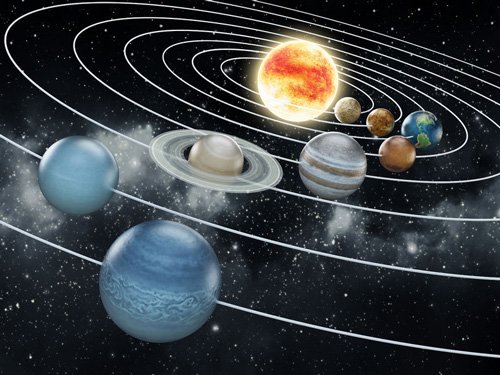
The Sun and everything that circles it form together a organisation called the solar system (solar = of the sunday). In our solar system, in that location are additional 7 planets, and dwarf planets (planetary objects which do non qualify as planets).
Each of these planets takes a different amount of time to travel around the Sunday. For the Globe, this journey is 365.25 days long, but for a faraway planet like Neptune, it takes 165 years. At that place are smaller objects which exercise not circumvolve the Sun, but around these planets. They are called satellites, or moons, only like Globe's only natural satellite.
Click Here for Footstep-by-Step Rules, Stories and Exercises to Exercise All English Tenses

Mercury
The planet closest to the Sun is named later Mercurius, a Roman god. Being a messenger god, Mercurius moves around speedily, so his proper noun was a good fit for this planet because it travels the shortest corporeality of fourth dimension effectually the Lord's day.
Because it is then close to the Sun, Mercury is a really hot planet. During the day, the temperature can go upwardly to 840 °F (450 °C). However, at night, the planet cools down speedily, and the temperature drops to – 290 °F (-180°C).
Mercury has a huge atomic number 26 core, and a very thin temper (a mixture of gases around a planet). It tin sometimes be seen from Earth.
Venus
Venus is the Roman goddess of dear. The second planet in our solar organization was considered to be the brightest object in the sky and one of the most beautiful sights, and this is why this goddess was chosen for its name.
This is a rocky planet with very thick clouds which foreclose us from seeing its surface. Certain radars have detected multiple volcanoes on Venus. One such volcano is Maat Mons. This five.6 mile (9km)-alpine volcano is constantly surrounded past lava, hot liquid rock, due to its regular activity. Venus can sometimes exist even warmer than Mercury.
Earth
Our planet Globe is the only planet which was not named after a god or a goddess. In Latin, our planet is known as Terra, meaning "the basis". Terra is also the proper name of the Roman goddess of the globe. Gaia, deriving from the Greek Ge, pregnant "country", is the Greek goddess of the earth.
Instead of Terra or Gaia, the mod term "Earth" was preferred. It developed from an Old English noun eorðe, which also ways "the ground".
Dissimilar all other planets in our solar system, Earth is the only 1 which has the right conditions for life. There are oxygen and h2o, and the temperature is warm plenty, thanks to which millions of species alive on our planet.
Mars
Mars is known as the Crimson Planet. What makes it and then bright ruby-red is rust, a scarlet-brown substance that forms on atomic number 26, is in its soil. All the same, when information technology came to naming the planet, people associated the blood-red colour with claret and war, which is why borrowed its name from the Roman god of state of war.
H2o on Mars has been frozen into rocks, so there is a suspicion in that location could be primitive life forms on this planet. Nosotros also know that potent winds, which embrace the entire planet in grit, oftentimes occur on Mars.
Jupiter
Jupiter is the largest planet in our solar organisation. It is xi times wider than Globe. For this reason, both the Greeks and the Romans named information technology afterward their supreme gods. In Greek, this planet was known as Zeus, while the Romans called it Jupiter.
This planet has many moons. Four largest ones were discovered past Galileo Galilei, an Italian astronomer, in 1610. The smallest of them, called Europa, is covered in ice, and so scientists believe this satellite may support some life forms.
Saturn
In Roman mythology, Saturn is a version of the Greek God Cronos, Zeus' father and god of agronomics. This planet has a large number of satellites (53 of them).
Most of them were named later on Titans, brothers and sisters of Saturn in Greek mythology. The largest moon, called Titan is even bigger than Mercury.
This planet is recognizable by its system of seven shining rings which circle the equator, the line which is half-distance betwixt two poles. They look solid, but in fact they are scattered pieces of rock and ice.
Uranus
The sixth planet, Uranus, was discovered in 1781 by a British astronomer Willian Herschel. Upon this consequence, Uranus became the first planet to be discovered with a telescope, a device which makes faraway objects look closer and larger.
Herschel wanted to name the planet after King George 3, who was and so the ruling monarch of the British Empire. However, in the same yr, the planet was named Uranus, after the Greek god of the sky, and the father of Saturn. Uranus has 27 moons.
Neptune
Johann Gale, a German astronomer, was the commencement to observe the eighth planet in 1846. The international astronomical community decided to requite this planet a Roman name after the god of the ocean. At that fourth dimension, it was believed that Neptune was the furthest planet in the solar arrangement, watching over the "body of water" that we called the infinite.
Out of all the planets in our solar system, Neptune has the nigh powerful hurricanes. Its winds blow at speeds upward to 750 miles (1200 km) per hour. Due to the presence of methane gas, this planet appears to be deep blue.
Pluto
Pluto is the god of the underworld, living in a nighttime and cold place. Existence and so far away from the Sun, this dwarf planet is supposed to be very dark as well. Temperatures are as low every bit -369 F (-223 C), and it takes Pluto 247.7 years to travel around the Sun.
Pluto was the concluding planet to be discovered. In 1930, it was spotted past a U.s.a. astronomer Clyde Tombaugh. In recent years, there has been a disagreement almost Pluto's status, which is why it was declassified. Because it is small and different from other planets, it is considered to exist i of the five "dwarf" planets, but non anybody supports this opinion.
Comprehension Exercises
Vocabulary Questions
- What does "radar" hateful?
- system that tin find the position of objects which cannot be seen
- tool used to mensurate the dimensions of objects
- group of scientists
- What does "suspicion" mean?
- feeling that something is incommunicable
- feeling that something may be true
- knowing that something happened
- What does "scattered" mean?
- standing close to each other
- covering a broad area, disordered
- false, appearing to be true
- What does "solid" hateful?
- firm, stable in shape
- liquid, fluid
- valuable, worthy
- What does "archaic" hateful?
- highly developed
- the almost important
- very basic
Collocation Questions
- Earth is the simply planet with the right ___________ for life.
- situation
- conditions
- context
- The Moon is our planet's but ___________ satellite.
- natural
- existent
- native
- Saturn's rings are scattered ___________ of rock and water ice.
- bits
- scraps
- pieces
- Scientists believe Europa may back up some life ___________.
- forms
- shapes
- structures
- The proper noun "Mars" was borrowed ___________ the Roman god of state of war.
- by
- from
- of
- Some radars can ___________ volcanoes on Venus.
- spot
- note
- find
- Neptune is ___________ planet.
- an outlying
- a faraway
- a afar
- At that place might be ___________ life forms on Mars.
- unrefined
- elementary
- primitive
- Neptune has the most ___________ hurricanes.
- powerful
- forceful
- mighty
- Strong winds frequently ___________ Mars in dust.
- surround
- cover
- enfold
Wh Questions
- How was Uranus discovered?
- with a radar
- with a spaceship
- with a telescope
- Where does the name "World" come up from?
- Old English language
- Latin
- Greek
- Why practise scientists believe there might be life on Mars?
- because people believe in aliens
- because in that location is frozen water
- because Mars has the right conditions for life
- What makes Neptune await then blue?
- a big ocean
- the clouds
- a gas
- Which planet is the largest?
- Earth
- Jupiter
- Neptune
Evaluating Statements
- Based on the data in this lesson, which statement is true?
- Galileo Galilei discovered Jupiter.
- Galileo Galilei discovered several Jupiter'due south satellites.
- Based on the information in this lesson, which statement is false?
- Everybody agrees that Pluto is a planet.
- Present, most people call up Pluto is not a existent planet, but a "dwarf" planet.
True or Faux?
- Based on the information in this lesson, is the following statement true or faux?
"The temperature on Mercury is always high."
- True
- False
- Based on the information in this lesson, is the following statement truthful or false?
"In Greek mythology, in that location is a goddess of the globe chosen Gaia, but this proper name was not chosen for our planet."
- True
- False
Answer Key
i. A | 2. B | three. B | four. A | 5. C | 6. B | 7. A | eight. C | 9. A | ten. B | 11. C | 12. B | 13. C | xiv. A | fifteen. B | 16. C | 17. A | 18. B | nineteen. C | 20. B |21. B | 22. A | 23. B | 24. A
Source: https://www.really-learn-english.com/english-reading-comprehension-planets-of-our-solar-system.html
0 Response to "Can You Fit All the Planets Between the Earth and the Moon"
Post a Comment