. Who was Giuseppe Garibaldi and what was his importance to the unification of Italy?
 Giuseppe Garibaldi (1807-1882). Garibaldi was a key effigy in the Nineteenth Century motility for Italian unification. Garibaldi became an international figure synonymous with promoting national independence and republican ideals. He led successful military campaigns in both Latin America and Europe and became known as the 'hero of two worlds'. His efforts in Italian republic played a very significant part in leading to Italian unification.
Early life Garibaldi
Garibaldi was born iv July 1807 in Nice, France. His family were fishermen and coastal traders, and for 10 years he served equally a crewman himself. In 1833, he served in the Navy of Piedmont-Sardinia. During a voyage to Russia, Garibaldi became acquainted with the Republican ideas of Giuseppe Mazzini. Garibaldi enthusiastically supported the aims of Mazzini's Young Italy and became a life-long supporter of Italian unification under a autonomous Republican authorities. In 1834, Garibaldi participated in a failed insurrection in Piedmont, and like Mazzini was exiled to France.
Garibaldi in Latin America
From Marseille, Garibaldi sailed to Brazil, where he became involved in the crusade of Farrapos (Ragamuffin) rebels who were trying to proclaim some other commonwealth within Santa Catarina, Brazil. Garibaldi also became involved in the Uruguayan civil war, raising a modest Italian strength. Here in Uruguay, Garibaldi'southward forces became well known for wearing their distinctive red shirts, and they were oftentimes referred to as the 'carmine shirts.'
The fight for Italian independence
In 1846, news from Italia encouraged Garibaldi to return home. In 1846, the new Pope, Pius Nine instituted liberal reforms which encouraged Garibaldi to be hopeful of progressive change. In the revolutionary year of 1848, Garibaldi found himself dorsum in Italy and he offered his services to the Sardinian Monarch – Charles Albert. Although Garibaldi was a Republican, he was willing to sacrifice his republican ideals in the hope of supporting Italian unification first. However, despite small success at Luino and Morazzone, the Offset Italian War of Independence was unsuccessful.
In 1849, Garibaldi was in Rome, which had simply been declared a Democracy, still, it was under assail from French forces loyal to the Pope. At the asking of Mazzini, Garibaldi led the military defence of Rome and scarcely escaped with his life. Faced with the overwhelming numerical superiority of the French, Garibaldi had to withdraw his forces to the Apennine mountains.
Depleted in resources and lacking the back up of the regime, Garibaldi was forced to emigrate again. This time he moved to New York, US where he joined a customs of Italian expats. Merely, Garibaldi was soon on the move again, sailing a trading send 'The Carmen' around the earth. In 1854, Garibaldi sailed in some other transport for Tyneside, England. As in many other parts of the world, Garibaldi was warmly welcomed past the working men of Tyneside, who saw Garibaldi as a defender of democratic ideals and opposing injustice.
Garibaldi returned to Italy in 1854, when he used an inheritance to buy a farm on a northern island of Sardinia. For a few years, he was able to devote himself to agriculture. However, in 1859, the Second Italian War of Independence broke out and Garibaldi was appointed a major general with a guerilla forcefulness based in the Alps.
Garibaldi felt supporting the Piemontese monarchy was the best chance of achieving Italian unification and then he once again sidelined his republican ideals to work towards the platonic of Italian unification.
Campaign of 1860
In 1860, he successfully led a relatively minor force to military victory in Sicily. By defeating the Neapolitan troops with a diverse band of volunteers and local peasant support, Garibaldi gained worldwide renown and became a hero for the Italian cause.
Subsequently conquering Sicily, he sailed to mainland Italia (with the help of the British Majestic Navy) and led his growing volunteer army to Naples. The advancing army was welcomed by the Italian population. But, it was with the help of the Piemontese Regular army that Garibaldi was able to defeat the large organised Neapolitan ground forces.
Garibaldi would take like to continue his march onto Rome and create an Italian republic. But, he knew his army was besides minor – relying on his much stronger Piemontese marry. Garibaldi agreed to give his recent gains in Sicily to Victor Emmanuel 2 – King of Piedmont equally a mode to effectively promote Italian unity. Garibaldi saw Victor Emmanuel Two as the effigy who could most finer bring near the unification of Italy.
"Providence has presented Italy with Victor Emmanuel. Every Italian should rally round him. By the side of Victor Emmanuel every quarrel should be forgotten, all rancor depart. Once more than I repeat my boxing-weep: "To arms, all-all of you!""
– To Artillery, 1860
This coming together on the 26 October 1860 is considered a very significant appointment in the quest for Italian unity. Garibaldi greeted him as King of Italy, and this helped cement the idea of Italian unity. After this momentous occasion, Garibaldi rode to Naples non wishing to receive any accolades for his services.
Later Campaigns
Although this was a step towards unity, Mazzini and Garibaldi notwithstanding desired to run into a republic and as well come across the inclusion of Rome and the Papal States.
Assuming he would have the support of the new Italian regime, Garibaldi marched to Rome against the forces of Napoleon 3. However, fearing the reaction of Catholic forces sympathetic to the Pope, the Italian government refused to back Garibaldi's attempt. They even sent Italian forces to defend Rome against Garibaldi. Garibaldi was injured in the foot, only the fighting concluded quickly. Garibaldi did non desire his soldiers firing on swain Italians. Once more, Garibaldi was willing to swallow his pride for the long-term goal of Italian unity.
Garibaldi returned to fight for Italy in the Third Italian War of Independence. Garibaldi led his Alpine troops in Trentino and was moderately successful. Due to the strength of Italia's ally – Prussia, Republic of austria ceded Venetia to Italia, but Garibaldi'due south gains in Trentino were lost.
Garibaldi continued to agitate for the end of the papacy and led another small strength confronting the Rome garrison. Simply, Garibaldi was unsuccessful and suffered another injury.
Garibaldi the Internationalist
Garibaldi dedicated his life to the crusade of Italian unity, but he was as well interested in republic throughout the world. In 1861 at the outbreak of the American civil war, he urged Abraham Lincoln to make the civil war conditional upon ending slavery. Garibaldi was held in such high regard, that Garibaldi was even offered a command in the Matrimony army. Garibaldi rejected the offer because he wanted Lincoln to brand firm opposition to slavery. When Lincoln finally agreed to the Emancipation Annunciation in 1863, Garibaldi threw his whole political support backside Lincoln's endeavor.
In 1870, the fall of the Second French Empire led to the creation of a new France. Despite fighting French forces for many years, Garibaldi was truthful to his Republican principles and switched allegiances in 1870 to offering his back up to the new French republic.
"Yesterday I said to you: war to the death to Bonaparte. Today I say to you: rescue the French Republic by every means."
Every bit was typical with Garibaldi, he backed up words with deeds and went to France to assume command of an regular army of volunteers.
In 1879, Garibaldi founded the "League of Democracy" this advocated universal suffrage, female emancipation, the abolition of ecclesiastical holding and a standing ground forces for national unity.
Along with Giuseppe Mazzini, Garibaldi supported the creation of a European federation. He expressed an expectation that it would be a greater Germany that would lead a united Europe.
Garibaldi died on 2 June 1882, at the age of 75. He wished to accept a simple cremation, though he was buried by his farm on the island of Caprera.
Personal Beliefs
Garibaldi was strongly anti-clerical and anti-papacy. However, in some writings, he supported Christianity.
"I am a Christian, and I speak to Christians – I am a true Christian, and I speak to true Christians. I honey and venerate the faith of Christ, considering Christ came into the globe to deliver humanity from slavery…"
Still, his approach to Christianity was more individualistic with little involvement in the church building.
He was a leading effigy in the Il Risorgimento (Unification of Italy). He was a fellow member of Mazzini'due south Immature Italy and the Carbonari. Towards the terminate of his life, he became more sympathetic to socialism, but by and large, he didn't concentrate on social reform.
He was besides a Freemason and saw the organisation equally an opportunity to spread progressive ideas within an international move.
Garibaldi was considered to exist an honest homo without desire for swell name and fame. This personal nobility and his military victories helped to gain the support and dearest of many ordinary people. His sincerity attracted many to back up his cause of Italian unification. Ironically, despite being a smashing military strategist, Garibaldi became increasingly wary of war and expressed pacifist ideals towards the end of his life.
He was married three times and had four children with his outset wife, Anita.
Citation: Pettinger, Tejvan. "Biography of Giuseppe Garibaldi", Oxford, UK.www.biographyonline.internet Published 12th Jan. 2013. Updated 20 January 2018.
Garibaldi: Hero of Italian Unification
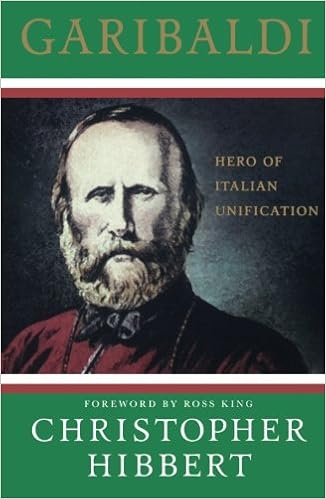
Garibaldi: Hero of Italian Unification at Amazon
Related
 Revolutionaries – People who inspired or began revolutions. Including Spartacus, Joan of Arc, George Washington, Karl Marx.
You can read more than at our privacy page, where you tin change preferences whenever yous wish.
Source: https://www.biographyonline.net/politicians/europe/giuseppe-garibaldi.html
0 Response to ". Who was Giuseppe Garibaldi and what was his importance to the unification of Italy?"
Post a Comment