Pop Matters Review of the Holy or the Broken
A new book traces the the song's strange rise to popular-cultural ubiquity.
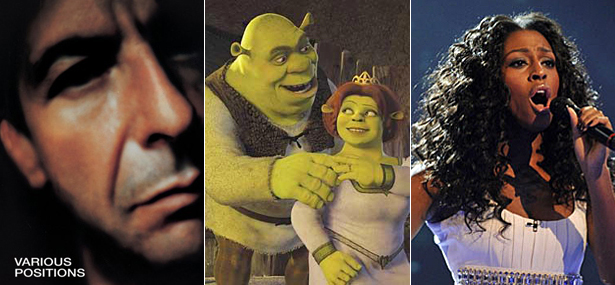
Columbia/Passport; DreamWorks; ITV
Popular standards don't actually become written anymore. Almost of the best-known standards were composed earlier the inflow of rock and gyre; perhaps something about the new brand of mass-marketed, Ed Sullivan-fueled stardom just didn't quite jive with the generous old-world tradition of passing songs around the circuit, offering to share.
Related Story

And so when an obscure Leonard Cohen vocal from 1984 was resurrected in the '90s, then repurposed and reinvented past other artists so many times it became a latter-mean solar day secular hymn—well, that was kind of similar a pop-music unicorn sighting.
Alan Light's new book The Holy or the Cleaved: Leonard Cohen, Jeff Buckley, and the Unlikely Ascent of "Hallelujah" traces the baroque cultural history of that very unicorn: "Hallelujah," a vocal that lay fallow in Cohen's vast repertoire for more than a decade earlier its popularity surged up once again with a posthumous Jeff Buckley single. "Hallelujah" has metamorphosed over the years from a cheesy, reverb-heavy B-side oddity on an album Cohen's label rejected to a mystical, soul-stirring pop canticle that's played today at only every bit many weddings as funerals. Calorie-free reverentially details every phase in the evolution—and along the way, he reveals the compelling stories behind some of its most iconic interpretations.
Leonard Cohen's original appeared in 1984 as the first runway on the second side of his album Various Positions. Though he'd composed some 80 verses over the class of five years or and so, co-ordinate to Light, he whittled the song downward to four for the final studio recording.
Cohen has always been ambiguous about what his "Hallelujah," with its sexual scenery and its religious symbolism, truly "meant." "This world is total of conflicts and full of things that cannot be reconciled," Cohen has said. "But there are moments when we can ... reconcile and embrace the whole mess, and that's what I hateful past 'Hallelujah.'"
According to producer John Lissauer, the dramatic, synth-heavy original recording of "Hallelujah" was "gonna exist the quantum" on Diverse Positions. "'Hallelujah' just jumped out at you," Lissauer told Light. But when it reached Walter Yetnikoff, the president of CBS Records, Yetnikoff was puzzled: "He said, 'What is this? This isn't popular music. Nosotros're not releasing it. This is a disaster.'"
Thus, "Hallelujah" wasn't fifty-fifty heard in the Usa until Various Positions was released by some other characterization. And fifty-fifty then, it failed to make an impression on the radio or the charts, where fifty-yr-old Cohen was competing against the likes of Michael Jackson and Madonna.
Jeff Buckley, a hungry young vocalizer-songwriter from California, showtime heard "Hallelujah" on a Leonard Cohen tribute album he discovered in a friend'southward dwelling while true cat-sitting in Brooklyn in 1992. He began performing the vocal regularly in New York'due south East Village clubs, and called it "a hallelujah to the orgasm ... an ode to life and honey."
Buckley's close friend Glen Hansard—who went on to win an Oscar in 2007 for his song "Falling Slowly," from Once—had moved to New York with him, and described Buckley'southward rendition of "Hallelujah" as a loving critique of Cohen's somewhat stoic original: "He gave us the version we hoped Leonard would emote, and he wasn't afraid to sing it with absolute reverence. Jeff sang information technology back to Leonard as a honey song to what he achieved, and in doing so, Jeff made it his own."
Buckley'southward rendition made it onto his simply full-length album, 1994's Grace. The song and the album went largely unnoticed until 1997—when both took on a new, haunting significance after Jeff Buckley drowned in the Wolf River in Tennessee.
For a 1995 Leonard Cohen tribute collection called Tower of Vocal, U2's lead singer Bono took reward of the opportunity to record one of his favorite then-underappreciated Cohen compositions. The U2 frontman went a counterintuitive management with it, enlisting the aid of a Scottish remixer named Howie B. to produce a thumping trip-hop arrangement.
"While in that location might seem to exist no vocalist also equipped to handle the vocal's balance of the earthly and the spiritual," Light writes, "Bono's 'Hallelujah' is, unfortunately, simply awful."
Bono, in recent years, has come to agree. When Light talked to him for the volume, Bono's first words were, "I wasn't sure why I agreed to do this interview, but then I remembered that I needed to apologize to the world." He continued: "The lyric explains information technology best. At that place's the holy and the broken hallelujah, and mine was definitely the broken ane. ... It was a snapshot, a Polaroid, of a identify I was in, but y'all really shouldn't get putting these things out when they're done in such a private way. Intimacy was the currency of the occasion."
There'due south a scene in 2001'southward Shrek , just after Shrek and Princess Fiona have angrily parted means, where the titular ogre pines for the princess just every bit she's joylessly preparing herself for a wedding to a tiny prince she doesn't love. Information technology'due south a poignant moment in an otherwise raucously funny film, and Shrek's musical directors had been testing out sad vocal after lamentable vocal earlier they stumbled across "Hallelujah" on the soundtrack to Basquiat.
The two musical directors tried the Leonard Cohen version and the Jeff Buckley version over the scene, but ultimately settled for a rendition by Welsh singer John Cale. "The song came at a moment of emotional irony, taking something that'due south a celebration and playing it against itself," codirector Andrew Adamson says. The execs, to their surprise, loved information technology: "I expected the studio would push me to do something more than pop, which they frequently do, but the emotion really outweighed the expectation."
For label-loyalty reasons, the soundtrack to Shrek included not the John Cale version, but a straightforward piano-accompanied version past Canadian musician Rufus Wainwright, modeled afterward Cale's.
"Wainwright laughed as he recounted how his own jealousy had prevented him from paying much attention to Buckley in the '90s," Low-cal writes. But later Buckley's decease, Wainwright recalls, "I was lonely and probably on something. I put his version of the vocal on, and it was this kind of catholic communion. It kind of hitting me how great he was, and how fabled the song is, and how foolish I had been for being so fiddling."
It was on the force of Wainwright's and Cale's renditions that "Hallelujah" truly became a miracle—half dozen-year-one-time kids, as Adamson puts it, were all of a sudden singing "Hallelujah," and adults came to know information technology as the vocal from Shrek.
In the post-obit years, "Hallelujah" found explosive popularity on tv and in movies. Imogen Heap'southward rendition, recorded for the third-season finale of The O.C. in 2006, became part of O.C. lore as the vocal that played over Marissa's death. Merely it almost didn't happen at all.
Heap initially felt there was likewise much force per unit area in performing what was fast becoming such a famous and beloved vocal. "I had actually just sent an e-mail to the testify saying I was sorry, but I wouldn't be able to give this the time it requires," Heap recalls in Holy or the Cleaved. "I was in the shower and feeling a bit sad about it, and I started singing it and thought, 'Why don't I just practise it this way—do it a cappella, with no music or production, equally if I were singing in the shower?' So I got out and I sent them another electronic mail back."
Regina Spektor was i of the first high-contour artists to repurpose "Hallelujah" for a religious setting. In 2005, the 25-year-onetime Spektor performed a simple rendition with pianoforte and cello at a concert for the Jewish Heritage Festival.
"Cohen writes a lot with biblical symbolism at the forefront of his mind," she told Light. "Having gone to yeshiva and studied those stories, I know that all the biblical things are so unique lyrically, and he uses them so freely, simply you lot don't have to know the stories to appreciate the song."
The "wistful" rendition past k.d. lang, Cohen'due south fellow Canadian, ranks among Cohen's favorites. According to Calorie-free:
[Cohen's] companion/collaborator Anjani Thomas said that later on hearing lang perform 'Hallelujah' at the Canadian Songwriters Hall of Fame in 2006, "We looked at each other and said, 'Well, I call back we can lay that song to remainder now! It's really been done to its ultimate, blissful land of perfection."
Alexandra Shush, a 2008 finalist on U.k.'s The X Factor, might win the prize for the near controversial rendition of the Cohen classic. Known for her soul power more her subtlety, she was initially dismayed at the news that she'd been assigned the song for the final contest.
"I idea, 'Cor, I've lost already,'" Burke told Low-cal. Burke then chosen her mom, who brash her to heed to the song and then recollect. "I grew up listening to Motown and soul records, and I realized in that location were all these different versions of 'Hallelujah,' but there wasn't a soulful one. ... I called my mum back and told her I was going to Whitney-fy it, really brand it soulful, and she burst into tears on the phone."
Backlash, of course, ensued. But with the release of "Hallelujah" as a unmarried, Shush became the first British female solo artist to sell a million copies.
In 2010, as Low-cal puts it, "the 'Hallelujah' brand was thriving." So when MTV produced a "Hope for Haiti Now" do good concert for victims of a January earthquake, Justin Timberlake and his friend and collaborator Matt Morris knew information technology could be the perfect vocal for the occasion—with a few minor tweaks.
Timberlake altered some of the chord constructions to create a sound that was more uplifting than melancholy and deleted some of Cohen'southward original sexual imagery. "'Call up when I moved in you,' that's only way as well intimate for something like this," Timberlake told Light. "But 'peradventure there'due south a God higher up,' that seemed universally appropriate for what was happening."
Critics were caught off-guard by the poignancy in Timberlake's rendition. "It was more ragged and more powerful than anything you might await from the former NSync-er," Calorie-free writes. "It was the broken hallelujah in full force."
Source: https://www.theatlantic.com/entertainment/archive/2012/12/how-leonard-cohens-hallelujah-became-everybodys-hallelujah/265900/
0 Response to "Pop Matters Review of the Holy or the Broken"
Post a Comment